
Mare Euthanized during BLM Wild Horse Roundup - Photo Story
Photos and narration from a locally protested wild horse roundup which ended with the loss of life.
Once every 5-10 years, the Bureau of Land Management (BLM) assesses the wild horse population atop of the Little Book Cliffs Wild Horse Range in western Colorado, just outside of De Beque, and decide whether the herd is healthy enough to be left alone or if intervention is needed.
In 2024, around six years after the last horse roundup, the agency decided that the size of the herd was well over the decades-used Appropriate Management Level. The AML recommends how many healthy horses can occupy a certain amount of land, and plans began within the agency to remove around 100 of the estimated 220 wild horses on the range.

As plans were made to remove the horses with traps and helicopters, plans were simultaneously made to oppose the round up.
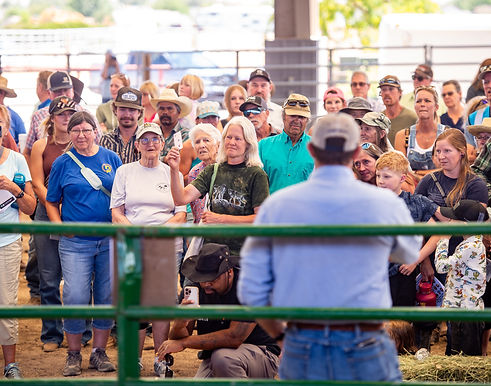
Wild horse advocates oppose the use of helicopters to steer wild horses into traps, a practice which Wyoming Wildlife Protection Group activist Madhu Anderson, seen middle, below, called "cruel" during a planned protest at the local Grand Junction BLM office on Sept. 7, 2025.
The sentiments were shared by Colorado Gov. Jared Polis in the summer of 2024, after he sent a letter to the BLM citing his "grave concerns" over the roundup, and urged the agency to delay its plans.


For two hours, protestors asked questions and debated BLM staff about the risks involved with using helicopters for the roundups, the quality of the land that the horses graze on, and about about previous roundups and the number or injuries involved with horses previously moved off of the range.
During the protest, BLM Grand Junction Assistant Field Manager Issac Pittman, middle, right, told protestors that in the 15 gathers he's supervised within the BLM district, he hasn't seen any horses get separated from their foals or break a leg while running from the helicopters, a few main concerns about the roundups from critics.
At the end of the protest, the BLM said it would go through with the round up while trying to minimize stress and harm to the wild animals. “Cruelty is like intentionally hurting something, which isn’t what we’re trying to do,” Pittman said. “We’re trying to do these gathers as safe and humane as possible, recognizing that we’re dealing with wild animals and difficult terrain."

Two weeks later on Sept. 12, a holding pen is established on private property nearby the horse range as a temporary holding facility, before the horses are moved to a permanent holding facility located in Cañon City, Colorado.
The media was invited by the BLM to photograph the few horses that had already been gathered at the holding facility, and to get photos of the helicopter and its crew as it goes to track down wild horses in the rugged 36,000 acres of terrain. That first day that media was invited, wind was too high and the helicopter was grounded.


The BLM then invited members of the public and members of the media to view the live trapping process of the horses a few days later on Sept. 17, but the wind was still too high and spectators were sent back without seeing the trapping process. The following day on Sept. 18, the BLM invited spectators once again to view a live trapping, this time in a canyon area of the range.
Members of the public and members of the media had a direct view into the middle of the canyon while standing on a surrounding hill, and a fenced trap was set up near the right side corner of the canyon for hoses to be guided into by a helicopter giving chase.

Over the next hour, around ten horses were led into the traps by the helicopter in small batches. The next group of horses being led was a muscular black mustang, a mare, and a foal, who were running across the canyon floor in an attempt to outrun the helicopter.
After the horses avoided the trap on the first try, the helicopter circled around chased the horses back across the canyon, honing in on the mustang as it broke away from the mare and foal at full speed. The mustang proved to be a challenge to follow, so the helicopter pilot focused back on the mare and the foal, now in the middle of the canyon.

Above, wild horses are led into a fenced trap at the end of the canyon.
Below, a pilot flies low to the ground to try to steer the mustang in another direction.

As the pilot gave chase back toward the trap, the mare was sprinting with the foal across the rugged terrain and broke her back left leg while running, likely stepping into a hole. Media and BLM officials froze in their tracks, as the helicopter calmly whirled overhead in a stationary position.
The mare tried walking and dragging its broken leg, but couldn't make it further than 20 feet, where it finally plopped down next to its foal, appearing to use the foal for stability to keep its head upright.

Contracted wranglers moved in on horseback to surround the mare, as the foal moved a away out of fear. At this point, BLM officials urged the viewing media and public away from the hill, where they were then informed that a veterinarian was on site to assess and likely euthanize the mare.
The BLM said that wranglers were moving toward the foal and were going to capture it, because they were unsure if it was old enough to be weaned off milk. But they also didn't want to cause any more stress to the animal.

That was the end of spectating for the day, as the BLM concluded that they had captured enough horses over the week to meet the appropriate management level.
After being assessed by the veterinarian on site, the mare was euthanized in the canyon with a .22-caliber gun. The BLM initially said that the wranglers would capture the foal because of its young age, but it was never captured. An advocate with the local horse group "Friends with the Mustangs" saw the foal on the range a couple weeks later traveling with an older mare.

Media traveled back to the holding facility seen a week earlier, to see it was now filled with horses off all ages, sizes and colors.
Above, the foal looks back it its mother as wranglers move in to capture and assess the injured horse.

After the horse was euthanized, Pittman said the mare was 24 years old and had a body condition score of 2.5 on a scale of 10.
"She was pretty old and not healthy. She had a foal with her so that kind of drags down her body condition a little bit, too. Based on that information she would have really struggled through this winter. ... It doesn’t mean we’re not sad about that loss or that it justifies it in any way. This is information about that animal,” he said.

In total, the agency permanently removed 98 of the 140 horses captured to reduce the population on the range to meet its designated appropriate management level. The remaining horses taken off of the range underwent fertility treatments before being released back to the range, a population control method the BLM aims to utilize more in the future. Subsequently, a second Little Book Cliffs horse died on Oct. 8 as a result of an injury it suffered during feeding at a temporary holding facility in nearby Mack, Colorado.

Following the removal of the horses from the range, volunteers like Dora Bensch, below, and Leiah Burnham stepped up to give horses like Yukatan and Neoko the best chance at new homes.

Volunteers trained the former wild horses to be docile around humans, to load in and out trailers, to walk across variable terrain and more, all leading up to adoptions in the summer.

Leiah Burnham leads her foster horse Neoko, 20 months old, over different forms of terrain while helping train the former wild horse from the Little Book Cliffs Wild Horse Area before an adoption event in two weeks.

Volunteers had varying levels of success training the former wild horses. Some horses like Yucatan were friendly, while others had a harder time acclimating to the pet life.

With the ability to load in and out of trailers, the horses were ready for adoption day one of two at the Mesa County Fairgrounds in Grand Junction, CO.

Community members bid on horses during the Colorado Mustang West’s adoption event at the fairgrounds on June 28, 2025.

Relic, who is just over a year old, takes a bite out of his biography card as his trainer John Boughton tells the crowd about the horse’s personality and training thus far during the Colorado Mustang West’s adoption event.

Becky Diehl smiles after winning the auction for Habanero, a former wild horse from the Little Bookcliffs Wild Horse Range that she has been training and growing a connection with.

Paisley Nickerson, 7, holds back happy tears after the Nickerson family won the live auction for Keno, a 2-year-old horse.

Ashlyn Harris, middle, 15, shares a smile alongside her twin sister McKenna and their mother, Tiffany Harris, after the family won the live auction for Paintbrush, one of two horses the family purchased during the Colorado Mustang West’s adoption event.

All 20 mustangs available for adoption at the June 2025 event found homes. Of the 98 horses gathered off of the bookcliffs,

Paisley Nickerson, 7, hugs a horse trainer through a fence as happy tears stream down her face after the Nickerson family won the live auction for Keno, a 2-year-old horse.